I tried to correct Raph’s graph because it doesn’t show what actually matters, from my point of view.
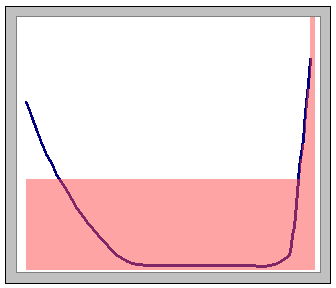
Raph’s graph isn’t supposed to figure out why some players leave the game. It should just compare the volume of content available with the volume of players. And what is relevant in THIS context is the volume of players at the same time. Also because it’s what matter to make the game accessible, bring the players together and enjoy the game. Something that is NOT POSSIBLE if all the players are spread thin around a desert.
So yeah, I’m not interested to find out why the players are leaving. Or maybe I am, but I think that another perspective will tell me a lot more about this specific argument.
Following this line of thought, Scott Hartsman wrote a “defense” of level-based games, as it is plausible considering that he is EQ2 producer and he must believe in what he does:
All of that “database deflated” content is called “shared experiences,” and they’re critical to a game’s success in the era in which they’re relevant. In the long run it loses value. That’s a given.
However, it’s absolutely critical to have it there in the short term, in order to get a game to the point where it can actually lose that value. That’s a problem of success. We should be so lucky to have that content beginning to lose its original value. We’ve both seen what happens when games (intentionally or no) appear to assume that success is a foregone conclusion and skip straight to “Aha! It’s going to lose value anyway. We’ll think ahead and not do as much of it in the first place, saving long term pain!” I’ve got all the proof I need to even more firmly believe that it doesn’t work that way if the goal is to satisfy those who enjoy character growth.
Here I believe that the only mistake Raph did in that article is about the title. I don’t think he is trying to prove that “levels suck” and that the successful games we have now are crap that shoud be thrown away and replaced. I just believe that he is trying to explore and delve in the mechanics that make levels fun. See their origin, discover their flaws and finding out if this research can open the path to something different that could solve or improve some of these aspects.
It isn’t about going “against”. It’s about creating a debate to use as a source. A source that is useful to improve and explore new possibilities more than rinse and repeat models that are now consolidated and “safe”, but that are still problematic. Are there possibilities to do better? Are there better solutions available?
The point isn’t about devaluing the current games. The point is perceiving possible developments and use the experience as a ladder to reach something else. It’s about taking risk. In this industry it’s *fundamental* that the risk is excused and motivated so that it is plausible and justified. This is why it’s overdue to analyze the flaws and propose ideas that MUST start from those problems and offer valid answers.
My idea, about what Scott wrote, is that the current level mechanics are killing these games, in the longer term. So an apparent, superficial “lesser issue” is, instead, CRITICAL for the future of an online world.
—
Here are my graphic leet skillz:

Now, the first graph represents the situation on a server a few days after the launch. The blue line traces the *activity* on the server in a set moment and not the number of characters created that never come back. In the first weeks all the players are concentrated in the first levels and then slowly decrease. During this phase there’s overcrowding and if you were in WoW at launch or at the launch of a brand new server you know how this is absolutely true. Everyone is running around the newbie zones and only a few players that never log out are able to reach an higher level compared to most of the other players.
Do you remember all the queues that lasted for multiple hours during the first days and all the players raging against Blizzard? That wasn’t simply the server load, it was because all the players were packed in the newbie zones and the early levels in general. The red line here shows the volume of the content available targeted at those levels. At the beginning of the graph there’s more of it to accomodate the number of players, but it’s still not enough. There’s more of it compared to the mid-levels because each race has its own newbie zone and content.
(the graph still doesn’t factor the “time” needed by each level, or the first levels still wouldn’t compare with the amount of content in the mid-levels, since each level takes more time and so requires more content available)
The second graph, instead, shows the situation of the server after a few months. Only a few new players are active at the same time and 99% of the game is emptier and lonely even if the game remains hugely successful. There’s basically more than enough content for the whole level curve. At the exclusion of the last few levels where all the players start to amass. If you notice, the red line at the end of the graph rises more than the red line of the first graph. This because Blizzard developed and added more “endgame” content. But as you can see, even after this effort, the content is still nowhere enough for the number of players that are hoarding at that end.
And this is why right now we have all the complaints about not enough raid content, or not enough viable progress for casual players after level 60.
Now what even Raph seems to overlook and that from my point of view is the BIGGEST problem, is that the situation shown in the second graph gets worse over time. Till the point it becomes a plague for the whole game. A plague that will just shatter the game in the longer term, creating a number of unsolvable side-effects that will slowly kill the game. Till the point where it will need a replacement because broken beyond repair. As I said the inequality between the content available at the mid-levels and the few players populating those zones is still somewhat bearable and a non-issue in WoW because the game is still hugely successful and, between alts and new players, even the early levels are kept somewhat playable and fun.
But what would happen if the game wasn’t a so huge success, and what will happen in the longer term? That the early game will be totally DESERTED. Only a few alts will dot the graph here and there, having an hard time finding someone alive to group with and, maybe, do those instances that were so popular the months before. The consequence of this trend is a recursive aggravation where less and less players enjoy the loliness of the early levels, deserting them even more till they won’t become just a lonely “desert”, but a swamp that you won’t be able to cross anymore.
And here we hit something bigger that was again always overlooked. Why the possibility to solo is considered so fundamental today? There are surely various reasons, but the main one is that the possibility to solo is a somewhat effective antidote to a deserted game. So, even if there aren’t enough players or if you cannot play during the peak time, the game remains playable. You won’t crash against impassable barriers because the content is still accessible. It’s not because playing solo is more fun. It’s because, after the gap between the players grew so huge, the solo play becomes the only viable solutions when playing with your friends is not anymore possible because the game put a WALL between you and them.
The huge gap that was created between the veteran players and the new ones will transform into an impassable barrier that will progressively isolate the game and the community (the elitism will to the rest). Slowly killing it in the longer term.
This is how MMORPGs die.
It’s true that extended treadmills and character progression are effective mechanics to retain the subscriptions. But it’s also true while going in that direction you progressively isolate the game from new players. It’s as conservative approach that aims to preserve the current situation as long as possible but that is still cruising toward an unavoidable collapse.
An healthy online world that slowly *grows* instead of slowly collapsing, is one where new and old players are brought together and not cut apart. A type of game where the content is experienced together and brings life to a world, and not burnt and thrown away as junk. The difference between a place where you live and one that you colonize and leech till there’s nothing left.
Perfect mirrors of the American capitalism and colonialism.