loopingworld.com

Books/mythology/metaphysics discussions moved to: loopingworld.com

This means that the site here won’t (usually) be updated and I’ll eventually copy all of book-related posts over there. The rest of the stuff will stay here for as long the site stays up (not planning of pulling it down for the foreseeable future).

UPDATE: I’ll sporadically still post here, but it will be for writing about roguelike development, tracking my own (lack of) progress, or other quirky gaming things.

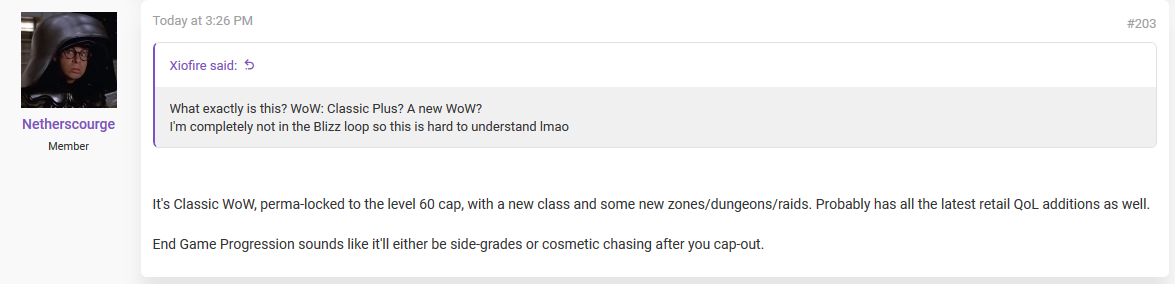
World of Warcraft Forever

So it goes nowhere and peters off into irrelevance?

Horizontal progression can be done well, but in WoW’s original structure? WoW vanilla certainly WASN’T horizontal, you just switched from mainly level-based progression to equipment. And raids demanding both preparation work and farming to gear up.

Side-grades are no-grades. Cosmetics? Really you think cosmetics alone sustain a whole game to play for years.

WoW does need progression, it’s a progression-based game. What it doesn’t need is adding pieces while removing previous ones. WoW should be about the long journey, without the rush. And challenging, more complex at whatever level you can afford. Make it require effort, give it depth, give it breadth. Horizontal progression in itself just closes it into a box that will become irrelevant 6 months after the hype dies off.

This will be wielded just as another proof to indicate that people love classic WoW just because of nostalgia, and not because modern WoW is seriously fucked in its idiotic, senseless game design. It’s just another cripple straw man to prove players wrong.

This, especially, is a contradicting point. So let’s discuss.

A progress-based game means you keep playing as long there’s content to chase. The content provides eventual power ups, that then lets you bite in new pieces of content that require the new power level as their floor. This is basically how all the main leveling to whatever level-cap, works.

The problematic part is the “expansions/resets that wipe the slate clean given that’s how they’ve always done it.” Because that’s entirely wrong. Expansions DO NOT NEED BE resets. Expansions should be expansions. New ceilings to reach, so that new floors are set. They shouldn’t overlap, like they are doing in retail. WoW = linear progression. Base game to 60 > exp 1 > exp 2 and so on.

Retail WoW is: tutorial island > new expansion > endgame. All other expansions? They got ditched from the progression, and every new expansion overlaps and replaces functionally the previous. It’s not outright deleted, like those GENIUSES at Bungie have done in Destiny (enjoy, retribution), but it’s still functionally useless, and so tucked away and made irrelevant.

We merely needed a WoW that keeps all content alive and in its best shape. Functionally relevant, given the value it deserves.

(my view still as it was)

Elden Ring Reforged, enshittificated?

I do feel like I’m personally attacked when I get dismayed by some game changes of “spaces” that are so niche but close to me. If it’s Nintendo, Sony or Microsoft (or most of everything), I look from afar, I think and judge and never participate. It’s just a silly world. But those niches that feel like home, where there’s no money involved, where it’s all about passion projects and hours invested without any payoff… being betrayed there hurts.

Being betrayed by Cataclysm, GregTech, Brogue… Now Reforged?

Here I write about minutiae but, as usual, it’s me and I take things seriously, however irrelevant. The non-irrelevant part, though is the feedback. I’ve never been on Reforged discord but countless reports (however anecdotal) point to an environment where all kind of criticism is suppressed, rather than acknowledged and discussed. Well, you can be the greatest genius of game design, but in the longer term not being able to parse and address feedback in a proper way will still ultimately sink your work.

Regardless, this is my soapbox and my own space, so I’m free to rant as usual. It won’t change a thing, but that’s a good price to pay. Understanding more important than doing, at least for me. We do things differently here. HERE. You get everywhere else for your own imperatives.

The bigger news about Reforged here is that they axed some custom modes: exploration, dragon, regeneration, full HP, Shura. Relaxed was a custom mode, but it was moved, exactly as it was, back to the standard difficulties.

None of this affects me PERSONALLY. My plan was to play Master mode, and I’d be using the old 2.2.9.6 regardless. But I don’t comment stuff with an egocentric, selfish perspective. Or I wouldn’t write on a blog. Having options and custom modes is one of the main features of this mod. It’s how the mod was “SOLD” to me, the very reason why I got interested, and the same, through word of mouth, when I encouraged other players to try the mod. Those options are a selling point, whether you end up using them or not. And they are, unambiguously GOOD. All of them.

Exploration mode is a “hard” mode setting, that only buffs standard enemies while leaving bosses untouched. It’s for players who like sustained challenge when fighting enemy camps and dungeons, but without boosting at the same time bosses. It is a legitimate wish. Not everyone loves fighting bosses all the time, with substantial difficulty spikes, only then maybe to have braindead gameplay as you explore the world at no challenge. The most fun I had in Demon’s Souls was exploring the first area of the castle. Sure, bosses suck in that game, but the dungeon-like standard adventuring experience, the exploration, the traps, it was that game at its most expressive level. Bosses can disrupt that type of flow. They are single, static encounters. Whenever they take the stage, the whole game gravity shifts around them. It only becomes a game where you fight bosses, with minor digressions where you kill some placeholders enemies and find your way to the next major encounter. Even if the bosses became the appeal of the “Souls” games, the rest is not superfluous. It might as well be the best form. This mode at least allowed players to peer into that and experiment.

Dragon mode is the exact inverse, and also very legitimate. You only want to fight bosses and tryhard? Speedrun through the exploratory parts of the game and keep those minor enemies trivialized? Why not. It’s a choice.

Regeneration mode is essentially a mage-casting mode, and very interesting. I personally think that the moment you avoid melee in a Souls game you essentially skip what the game does better, and you end up playing something that feels more like World of Warcraft. But if you really want to focus on casting, this is another legitimate option. Rather than casting and refilling “mana” through flasks, you get regeneration. It’s one less thing to think about because it means mana management doesn’t require strategizing when you press the key for the flask. You focus on the screen, you focus on the action. Meanwhile mana regenerates passively. It also allows for sustained fights, which are also my preference: with flasks you have a finite amount of mana to use, with regeneration you can play the long game. If I decided to play a caster archetype then this would likely be my preference.

Full HP mode may resemble the above, Regeneration, but for melee. There are some important differences. In a similar way, you don’t recover HPs using flasks, but you have more HPs by default. This is similar, since flasks mechanically extend the amount of HPs you have. In this case it’s like you pre-allocate those HPs. But since you decide when using the flasks, the total bonus HP you obtain varies. If you lost 20-30% of your health then it might not make sense wasting a flask. You wait to sustain more damage, but this is also risky because it opens to the possibility of getting killed by a following attack. That’s meaningful, expressive game, so not a good idea to remove. But this mode doesn’t give HP regeneration, and at the same time it significantly REDUCES damage, both from and to enemies. It means sustained combat of attrition. Less about single, fatal errors and more about the sustained performance. This is generally good. It lets you learn the fight and get better. The more it takes, the more skill matters because, with protracted fights, luck moves out of the picture. It’s still a very worthwhile option and one I’d actually try.

Shura mode, this one might be undercooked, I don’t know. It wants to be Sekiro-like and empower deflection play (since it’s added by the mod, by default). But I suppose that players who want to go there might have a more satisfying and full experience with Elden Vins. This custom mode is essentially a giant nerf to invulnerability frames, something I actually see positively, in abstract, since it’s a meta-meme of the Souls games, becoming “roll souls”. This “meta” assumed fact that as long you are rolling you become intangible. As if it makes any sense. That’s obviously a design abstraction to make gameplay work, but rather than being a technical compromise to eventually evolve away from, it became a staple of these games (I guess, again, Sekiro was built precisely to address the cementification of this silly gameplay). So, Shura mode, if you can’t roll because you don’t gain invulnerability, then you better defend and deflect. Or dodge in the sense of moving away from the attacks arcs, rather than into them. It’s, once again, a perfectly legitimate and worthwhile option. One I heard players actively wanting to try and install this mod BECAUSE of it. I just don’t know how well it works in practice.

This whole thing can be criticized not simply because of the choice to axe all these options at once, but for the path that lead to these removals. What is written in the patch notes is this:
– Removed the Special Difficulties menu due to it being entirely modes that were all outdated and generally untouched for years.

This doesn’t make any sense. All these changes were parametric, like x2 to HPs. Numbers don’t get “outdated”, merely because they are applied contextually. They are all high level adjustments made to the shape of the whole game, not micromanaged stats that are tweaked individually. From people reporting it seems someone complained on Discord that something wasn’t well balanced, a dev answering no one has tested these modes in a long time, another dev stepping in saying removing the whole thing would simplify development. And so it got all axed.

First, this mod has been in development, relatively playable and balanced, FOR YEARS NOW. It should be kept stable because it can be. You don’t go removing substantial features on a whim. Secondly, lets assume no one wants to address some minor problems as they are reported, that no one wants to maintain these options. DON’T REMOVE THEM. You have other options. Hide them away in a different menu where you WARN players that the modes might not work perfectly well. Hide them in a .ini file with a note on the wiki on how to enable them back. There’s literally no reason to hard remove these important features that still had a role in making the identity of this mod.

Then there are a couple other minor changes that I spotted myself. If in general whenever I looked ad Reforged gameplay changes I always thought they were brilliant in their design, radically improving the game, these two changes instead got my attention because they looked very incongruous and sloppy, compared with everything else (and again, appearing very late in the development of this mod):
– Players now visually deal 20% more damage in order for damage numbers to appear punchier. PvE enemy health and PvP modifiers were adjusted by 20% respectively to make this a visual change.
– Decreased the damage of successive light attacks by removing their progressive damage increase within a chain, with the exception of the final strike.

The first is objectively bad: bigger numbers are harder to parse. Want to take it seriously? Ok, then the “feel” is of course important. But it’s not 1990, the feel of combat depends on animations, effects, sound. Bigger number = good, is really a stupid point. You aren’t improving the feel, you are merely misdirecting.

But might it be that it was done differently? This is what someone replied:
The reason for point number one is quite simple: The mod has a lot of small granular ”buffs” that are too small of an increment to be visible. By buffing both HP and general damage the game stay the same, but those small buffs will be more apparent to the player. This is also for that reason that you have a thousand FP/Stamina: so that the devs may make even SMALLER buffs to give the illusion of depth to the system for buildmaking purpose. Ultimately this design becomes its worst enemy since builds needs to get the same small ”pieces” to be effective and you cant really combine different elements effectively because they are so small individually.

I don’t know if this is real or not, but adding granularity is legitimate. But that’s not what’s written in the patch notes. The MOTIVATION of the change is “in order for damage numbers to appear punchier”, whereas “expanding” numbers in order for small buffs becoming mechanically meaningful is a whole different matter.

What they wrote is that, internally, numbers stay the same BUT APPEAR bigger. Which is idiotic and objectively bad. What the other user said is instead that INTERNAL numbers are different and calculations include those numbers. If you add a 1% to a percent skill, the practical impact won’t be “felt”, but is still REAL.

Then the discussion might move to what the user added. It’s the good old argument of Diablo VS Path of Exile. On one end the design strategy is to use discrete skills that are impactful and actively change gameplay. Something felt immediately and substantially. On the other end you have the strategy of tiny increments that all together go to form a very specialized “build.” You don’t feel those tiny increments, individually, but you have granular control and can really shape the thing as you want. These are discrete game design choices that are both legitimate, it depends on context (and neither Diablo nor PoE commit to one or the other, internally things get a lot more mixed).

Reminds me of World of Warcraft beta, when… when was it? Maybe May or June before release. They decided to greatly boost armor values while telling players that mechanically nothing was changing. They needed bigger numbers because armor pieces were constantly dropping with the exact same numbers, all being sidegrades. By increasing the range, instead, it allowed for these pants to have a slightly larger number bonus, and so players feeling like they got upgrades to equip more frequently than before. I remember ranting at the time against this, because it also wasn’t clarified whether it was a COSMETIC change, or those numbers were still considered internally. I think in WoW’s case it was a mix of things. The numbers were internally “real”, but the actual “outputs” of these formulas were compressed. Meaning that numbers coming out would be approximate, and so those differences of +1 +2 in armor values were effectively cut off, and a mere illusion.

THIS IS BAD. THIS IS UGLY. Game design is an art in the sense that there’s an aesthetic value that you SHOULDN’T break.

Detail matters if it is modeled, otherwise it’s NOISE. That’s the same reason I ranted against Tarn Adams, Dwarf Fortress, when he added a million of stone types in the game. This good, right? NOPE. It’s fucking not! You add stone types if stone types DO SOMETHING. If stone types are mechanically IDENTICAL, then you added a bunch of meaningless noise to a game that is messy by default. To make things even worse because all these stone types are different colors, and you play in stylized fucking ASCII, where everything is abstracted, where information IS KING. And what you do is transform the MOST IMPACTFUL visual information, COLOR, into pure, distracting noise. This is a CATASTROPHE of game design.

Want to make a bunch of different stone types? GREAT. Give them different properties. Why “cave ins”, an important mechanic of the game, don’t factor STONE TYPE. Either you are mechanically consistent, or your game turns into an arbitrary mess of caveats. The more complex the game, and Dwarf Fortress is the max, the more consistent it needs to be. It needs to make sense mechanically.

Then we come to the other change. This one too quite baffling. I’ll repeat most of what I wrote on reddit. Attack chains have the purpose of goading players into being aggressive, because there’s a damage reward to “push” the chain. Otherwise, being combat risky, you’d favor mobility and stay defensive. Hit and run. You stay and hold your ground, to commit and get better damage. This is somewhat preserved by the final attack, with a bigger boost. But if your goal is to boost the impact and reward of completing the chain, then you can still do it by tweaking numbers, rather than REMOVING all bonus damage from the chain itself.

Both these things have an important FUNCTION. Removing one boosts the other, but it also kills the function itself.

In practice it makes gameplay worse. If you know the chain attacks do no bonus damage, then you know it’s all wasted effort unless you’re reasonably certain of being able to reach the end of the chain. If before the chain attacks were a variable, adaptable path. Something performative that articulates the gameplay and offers flexibility. With the damage bonus removed the light attacks merely become a “bridge” to get to the final attack. The result is that on one hand you have expressive combat, that depends on player’s choice and skill, on the other you have a hardcoded, binary path where you either hit and run, never committing, while waiting a long enough attack window where you hope having enough time reaching the end of the combo. Everything else becomes a mistake. You’ve sucked out, with a simple change, most of what makes the combat system varied and fun. Adaptable, personal in how aggressive you decide to be within the risk/reward formula. You transformed a range of possibilities into a binary path. Why.

(without considering that chain attacks, weapons, have their own animations and arcs, so they might be different in effective use. But removing the damage still blunts this aspect)

In practice this single change narrows down combat to a single optimized path, always exactly the same. Again, why.

May there be more to this? I’m doubtful, but maybe. I guess I’ll never know because with discord reputation being extremely hostile to feedback, and me having wasted WAY more effort writing this than it deserved, I’m now done with all this. It’s written, it’s known, it’s done.

More importantly: listen, talk. Embrace feedback and criticism. ENCOURAGE them. Keep the community open and welcome its diversity of opinion. Focus on motivations, not the person. That’s how you make a better work. Or don’t, who cares.
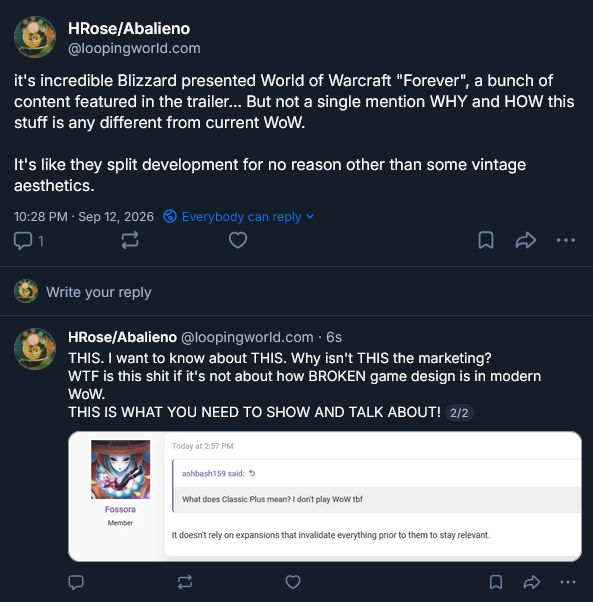
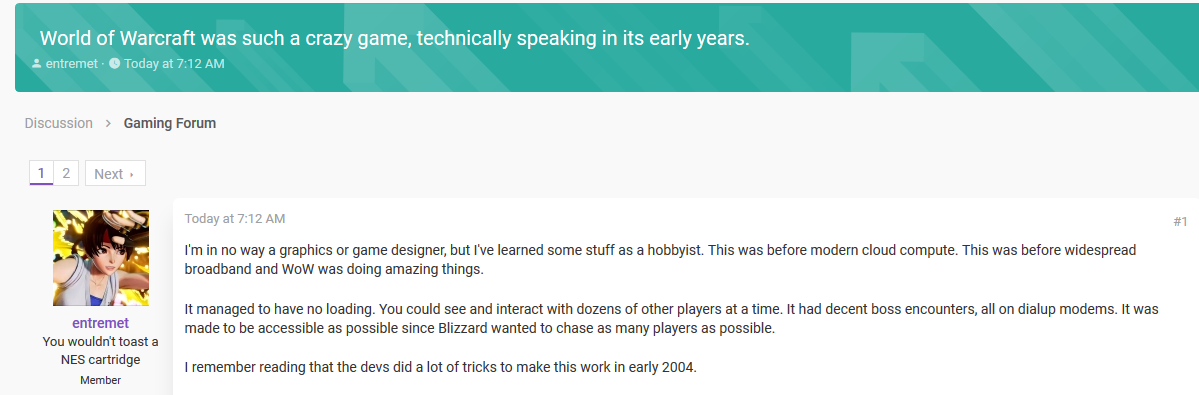
“World of Warcraft was such a crazy game, technically speaking”

I randomly bumped into this and feel like I cannot abstain to comment, even if I probably shouldn’t because why should I waste time on this…

What!? No, it wasn’t.

“This was before modern cloud compute” should already qualify the statement, as if it has any pertinence. “This was before widespread broadband,” and that’s true. But this was also WELL AFTER Dark Age of Camelot, that I personally played on dial-up, from Italy, connected to US coast servers, in RvR battles up to 200+ players (at that point the problem was split evenly: FPS performance going sub 10, your connection lagging like hell, and the servers themselves crashing badly, even if you locally solved one of them you’d still be victim to the others).

While I wasn’t much of a player and it took me forever to reach “endgame” RvR/PvP (on top of the fact I picked the terrible Infiltrator/stealth class), I was in a guild named Samas Gildae that dominated the US server it was on. This despite being all players connecting from Italy and frequently with hardware worse than mine.

Quality and innovation, that are pertinent to WoW, are all but “technical.” But you need to have a good understanding of the wider context at that time.

MMOs at the time were ALL technical trainwrecks. When it comes to pure technology advancements, MMOs were far behind any other type of software. This because the MMO/online field was a sort of no man’s land that was pioneered and conquered by COMPLETE AMATEURS. Just as it happened in the early years for all the other types of games. There wasn’t an “industry”, just a bunch of ambitious kids with some hacked competencies. I’m going to be vague and imprecise about things here, and I don’t want to document shit, the intent is to give the general picture. Devs that worked at Mythic, on DAoC, came merely from successfully running some textual multiplayer MUDs. They had some barebone online technology, bought a 3rd party graphic engine, and managed to make their own EverQuest clone that somehow ended up better in many aspects. This because EverQuest itself was a technical clusterfuck.

Pick any other singleplayer game, and they were ALL miles ahead of whatever was available as “online game.” Making a MMO was complex not in the sense of requiring bleeding edge technology, but in the sense of needing a sort of “jack of all trades” competencies. A bunch of systems that went from graphic engines, running large databases, connectivity and so on.

A dev studio with absurd tech competence like, say, ID software just couldn’t make a persistent online game. Merely because tech was always hyper-focused. You do one thing, and you do it well. Whereas MMOs where “we do all things and we do all of them bad.”

That’s why MMOs were shit not only in technical quality, but even in design and ideas in general. There weren’t competent game designers, and this became a chronic problem (that Blizzard solved obliquely). The game designers were more often than not programmers that ended up filling those shoes. It all grew organically in a very misshapen form.

That’s WHY, when WoW was announced by Blizzard, everything changed BEFORE showing even a single screenshot: this time it was a well established, successful studio with a proven history and solid budget, so an “industry”, that for the first time stepped in to make an MMO, that, again, until that point had been the domain of complete amateurs that improvised themselves a business (again, both an impressive skill and also a liability).

This all reads like I’m going against my own point, that Blizzard and WoW did indeed innovate technically by merely bringing the sheer force of their previous experience, but that’s again missing the point. A good chunk of the quality of the “tech” of WoW was about stepping back. At the time of WoW release there were plenty of games with higher graphical fidelity. There was a giant hunger for games that pushed the hardware (and very fast hardware evolution, people think things move fast now, when truth is they stalled). WoW was extremely conservative. If most other games were quick to embrace large worlds with heavy LOD (what is recognized as pop-in of detail) WoW was the grand, large rendering distance with no noticeable pop-in (compared to, say, Star Wars Galaxies that was more technically advanced, and yet had large building materializing in front of your eyes). But because object complexity and texture resolution was lowered accordingly, and priority given to art style, scale, sense of wonder, rather than minute detail and high fidelity. Not because today the game is old and shows its age, but because it looked “old” WHEN IT WAS RELEASED. It just didn’t feel any less impressive, because art compensated, and because resources were allocated competently.

The user above saying “it managed to have no loading,” which is true. But I also remember during the beta, in the summer: taking a flight path from the Dwarven city Ironforge(?), down to the human one, how’s it called Stormwind? No loading, but when I started on my hardware I had max FPS, and when I landed I was at less than 10. Performance TANKED. Logging off and back in would reset it. This was explained as “memory fragmentation”. Specifically by loading a tons of small object dynamically, as you fly between several zones, memory builds up and leaves gaps, creating serious performance issues. A Blizzard dev asked us specifically to run some debug commands and send the results. If I don’t misremember in a matter of couple of days they released a few client patches that MASSIVELY improved performance. But memory fragmentation was still an issue. Just less impactful. Memory management would be a critical area, for games, for more than 10 years, and still today. No one knows how to write a good memory manager. Today indie studios use stuff like Unity whose main feature is managing memory “automatically.” Which is one of the main reasons why Unity performance SUCKS.

Expanding a bit more on the concept of the “cloud” and networking in general, this is the area where Blizzard DIDN’T learn the lesson. The lesson being to decouple the characters records from the world servers. They made the same mistake of everyone else, and ended up at release with servers crashing and burning, some of them staying offline even for weeks. Then rinse and repeat for every new expansion or massive update. When PvP was released, some time later, it became that well know and short lived open-world PvP, up north in that zone between the two towns, can’t remember names. But the game was laggy, servers started to have problems, and Blizzard had to essentially nerf and forget about the whole thing. It’s fine if you have a bunch of players scattered across several zones, it’s not good if they all meet in the same place. DAoC was all about it, and became somewhat resilient, WoW just broke down, over and over.

Nowadays devs are still stupid enough to repeat the same mistakes (the lesson I mentioned above is STILL rarely applied, but at least it does exist, see Black Desert), with the difference that the servers themselves are not privately owned, but borrowed from Amazon. Therefore there’s a much better viable capacity of rapidly scaling up (and then down) server needs, than what was possible when you had to buy and set up your own servers. Sure you could buy a bunch beforehand, but when players activity falls down dramatically (because it will, no matter the success), you can’t just let unused servers sit there. Those are costs that need to be optimized. Amazon, being 3rd party, can always dynamically allocate those servers to someone else.

Coming to the qualities and innovation that made WoW a juggernaut, first to destroy the competition, then to sink the whole “nascent” MMO genre into near total annihilation. These are all about very simple ideas and common sense. Ideas that WERE ON THE TABLE for anyone to take them. MMOs were driven by blindness, rather than vision. Devs were all too close to what they were making to have even a vague idea of a direction or a plan. Every single one of them with a serious case of impostor syndrome, fearing that their job was ready to be taken by someone else.

For example, one main WoW “intuition” was creating this highway for leveling and progression that was “questing.” Pick up quests in a hub, go out filling objectives and come back to collect equipment rewards and giant blocks of experience. Basic, successful gameplay loop. Of course it’s easy to see something working so well, but not as easy to INVENT it. The problem here is how questing was executed in other MMOs. There were NPCs all around, 90% of them completely useless or just being vendors. Text/dialogue was always skippable “flavor”. In Ever-QUEST quests would be given completely at random, in the sense your level 1 character could prompt a random NPC and get a level 30 quest. Nothing would give you this information, that completing this quest, for you, is IMPOSSIBLE. But you also got close to zero info about what this quest wanted from you, or what you’d get if you miraculously managed to complete it. As a “newbie” you had NO IDEA what to do. The game was opaque and fighting against you. In the end you’d exit a town, find some sheltered tiny corner of some zone, pull a single enemy nearby. Then sit down several minutes to recover HPs and MPs. Then REPEAT FOR HUNDRED OF HOURS. It’s not an exaggeration. You wouldn’t explore, because the world was deadly. You wouldn’t experiment, because a single death could set you back an hour of pure grinding. And you wouldn’t talk with NPCs because they were all garbage. You just sat in a corner, pulled the exact same monster you killed before, hoping not to aggro anything else or you’d be dead. Repeat, forever.

Playing in a group was marginally better, because you could make some inroads within a zone, and get experience much, MUCH faster. But it was still risky, and if after an hour or two or trying to play solo, you got a group, the risk was that someone in that group would fuck up for whatever reason, and the group would immediately disband. In the rare case you happened to find a competent group that got experience fast, then you’d play for hours even if you didn’t want to, merely because that was a rare occasion you find once in a while. You either catch it while you can, or keep grinding for 0.0001% xp if you wanted to play on your own terms and convenience.

Those were the MMOs. Experience in torture and pure grind, and frustration. Of hugging walls and killing rats. Of running from unintended aggros all across a map (in EQ especially, either you made to the exit of a zone, or you’d be chased forever).

WoW merely took what was already there. Figured out the quests could structure progression, and so explicitly tell players “what to do.” But especially, made them visible when available with those giant exclamation marks. Those weren’t invented by WoW, but were there already in Warcraft 3. It just made sense, but it was also stuff that had been suggested for YEARS by countless players in forums. You just needed eyes to read. Because you don’t need a genius to realize MMO quests were SHIT. And MMOs didn’t invent QUESTS. You just needed to have played games before, to realize MMO quests were shit.

Accessibility made WoW popular. The MMO genre was like a niche of super dedicated players. Like a cloistered cult. The fact that these games were utterly unplayable and frustrating, punishing to the extreme, was like a basic feature. I mentioned quests. No one was meant to “play quests” like that, even. You were meant to read forums, wikis. The game didn’t tell you how to play, through its many nuances. It was an online game, and other players were the primary channel for INFORMATION. Either you joined some community, and you were manually guided through the game, or you’d give up. Or you’d play perpetually in a single corner of a single map, killing the same rat or spider or goblin.

WoW own doing was merely gawking at this scene. “What the fuck are they all doing? Why?”

(that, and poach some key EverQuest players to tell more precisely them what needed to be done)

A wolf in sheep’s clothing: Dario Amodei

This isn’t going me trying to be sarcastic, or hyperbolic, or whatever. I take things seriously and, naively, won’t read beyond what is written.

I think it should be fair enough to read this and “weigh” its meaning and intent:
https://www.anthropic.com/news/position-open-weights-models

Alright then. There are two groups, one asking for explicit bans, the other supporting open weights. Anthropic here saying they don’t belong to the first group, but as we’ll see in a moment, not quite to the second as well. I add a simple observation to this, but if you notice whoever ends up subscribing to one group or the other is ALMOST ALWAYS guessable (like 99% success of this heuristic) by looking at personal interests. OpenGPT asks for a ban, Nvidia, selling the hardware, wants it going on and on. It’s not like there’s any relevant analysis or logic, everyone is simply pulling toward the side that is more convenient. Not the one that is more correct, or complete. In “technical terms” they ALL come after the processes that drive them, not before. They are driven, they don’t drive this process.

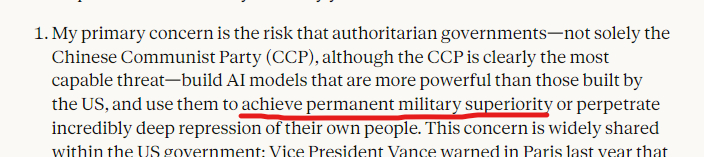
The rest of this quote is irrelevant, but the thesis as well. Is this just pure and simple imperialism? An American dude worrying of losing supremacy? China is certainly worrying, but the primary, worldwide threat, RIGHT NOW, is US fascism and imperialism. China isn’t actively bombing anyone, right now, the US are.

“Authoritarian governments” are worrying whether it’s the CCP, or US, or whatever, whoever else. It’s this whole SHITHOLE to be worrying. Bombs land whether or not driven by AI. Claiming this authoritarian problem as it is somewhat dependent on AI misses the point by miles. Authoritarianism is a problem WELL BEFORE AI. And AI is a problem, right now, because it is ALREADY in US authoritarian hands. Not as a powerful tool, but as an economic-destroying tool. It is devouring human resources in a way that is unprecedented on this planet.

The bottom line of all this, what Amodei is saying, is that the race to supremacy is legitimate. Whoever is at the top subjugates everyone else. Therefore, it’s better if it’s “us”, rather than “them.” Both can be authoritarian and destructive, but if it’s us being destructive, at least we destroy them, more.

Or: the problem is not the killing as a moral ground. The problem is seizing the means to kill, so that we are killers rather than killed.

Lex Luthor dilemma once again, as anticipated.

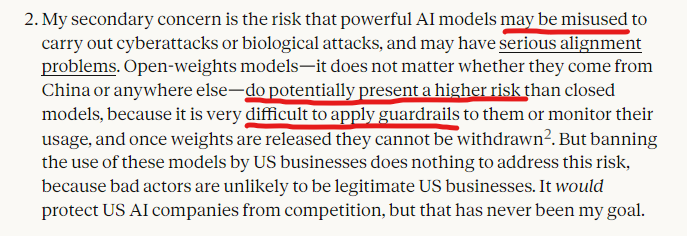
“Powerful AI models may be misused,” so what? The only distinction here is not epistemic, as it should be, it’s pure, once again, ownership.

WHAT IS MISUSE of AI? Who applies “guardrails”, and to defend whose interests?

Amodei here has already sidestepped and deleted any pretense of general regulation, any idea of universal, collective policies to apply outside biases. There are no rules, only control.

Here he’s saying that he’s not against a ban of Chinese AIs, but merely because he thinks the practical means as ineffective. He WANTS to ban Chinese AI, but in a way that actually works. The goal is the same, the debate is: how can US industry + US government continue to impose their own fascist control on the world? How can they stay on top?

The reason why this is all factual description is that he doesn’t acknowledge anywhere that the “misuse” can be THEIR OWN. They are FULLY RACIST in their own views (or in this case it’s less about racism and more as universally nationalist, but it amounts to the exact same thing). Whatever they do is right, whatever “the other party” does is dangerous and threatening.

(We’ll see below he’s for regulation, but it’s regulation of the public-facing offer, not internal development. So there are two halves, the risk posed by models available to everyone, where he wants to put “safeguards”, and the internal ones. In this case, since regulation is not as easy, he merely wants to seize power and be on top. Self-righteous dominance. Which is what I’m commenting, to be precise.)

US businesses are “legitimate.” Non-US businesses are illegitimate, or they decide if they are. They set safeguards, for you. Not for themselves, as they are the law, they have already ascribed to themselves the superior morality. They do not simply act as Kings of the whole world, they theorize their supremacy.

I have no idea about Amodei, the man behind the name. Haven’t done any research, or read interviews to gleam what kind of man he might be. I have no previous bias. But this is, if very slightly masked, the exact same white nationalist fascist supremacy that Elon Musk ascribes too. Slight different language, but exact same meaning.

If it was even in doubt if Amodei was in support of fair competition: he’s clearly not.

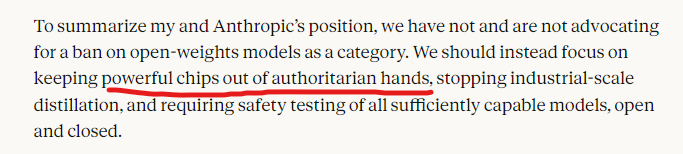
He’s saying: let them compete without the hardware to do the work. They likely will be able to do something, but starting with a significant disadvantage means we’ll always be far ahead.

This too was anticipated: AI companies cannot control USE of AI, so they are trying to close down ACCESS. They aren’t trying to use this tactics against China, but also against ALL other competitors. They are trying to seize the process UPSTREAM: control hardware producers, and through corruption, government contracts and sheer power, lock in those hardware producers to themselves, so that no one else can interfere.

This is pure delirium as it is both factually incorrect, and also going nowhere. If just above he complained that some policies aren’t wrong, in his mind, but don’t work in practice, here he propose exactly the same: something vague and with no practical application.

Even assuming that the initial statement is correct, and is not, what are these policies that “deter this behavior”? How?

A reminder that “distillation” is equal to the process that allowed these AI businesses to exist in the first place. They all started by stealing, now demand policies so that stealing stays as their own personal privilege.

Yeah, not much to add here because this is the only reasonable point.

But WHY it is the only reasonable point, compared to all the others? Because this is the only one where the problem is seen from an epistemic point of view that applies outside interests and biases. Everything else he wrote amounts to: how can we have universal policies where Anthropic makes all rules? Here we move to: how can we have universal rules that apply uniformly to everyone, INCLUDING ANTHROPIC?

Why all other points are intended to favor Anthropic, while damaging or hindering competitors, and only one is intended to operate outside bias? How can you think that is proposal is acceptable for anyone that isn’t you?

And please tell, how do you guarantee that these tests are enforced? How do you make sure that what’s hidden is not? Because it’s all self-defeating: if this regulates the public space, so the AI offered AS A SERVICE, it still does nothing for AI that is internally developed and used.

And here comes a well known pattern, now defined as “end times fascism”:
https://www.theguardian.com/us-news/ng-interactive/2025/apr/13/end-times-fascism-far-right-trump-musk

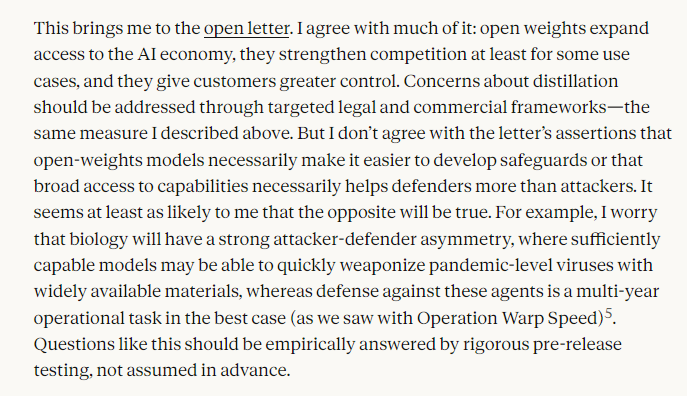
The problem of this (fascist) rhetoric, depicting a chilling scenario, is that it would like to be all about AI, but in the actual reality the leverage of this danger given by AI is quite minimal.

You could make maybe a case about “weaponize pandemic-level viruses with widely available materials,” through help of AI, but this is really a minuscule risk in front of a giant one that is ignored.

There are ALREADY giant capabilities of doing damage on an unprecedented scale, through viruses. This is nothing new, and we’ve been here a while. Only reason this hasn’t happened is that, as Covid has shown, no one has any control. While viruses can do more damage and slip out of control compared to atomic bombs, it’s not like, as humanity, we face these types of large scale threats for the first time.

AI moves close to nothing. It’s still the same stupid human beings, with too much power. It’s already a risk. It has always been a risk.

Amodei here just wants to be the man with his finger on the button. Because he thinks he knows better. Because he thinks he is the responsible king no one has elected. Because he happens to be rich and influential.

Who watches the watchmen? The Devil.

Hand them off, then.

You are the owner of authoritarian hands, working for an authoritarian, fascist government.

And if distillation was stopped, your business wouldn’t exist.

American thieving bastards cry someone else is stealing their thievery

As previously seen, if STEP 1 was evoking of good old RED SCARE, STEP 2 is all about remembering they already infiltrated the government, so it’s time to precisely use the law for its purpose: protect the thieves.

https://techcrunch.com/2026/07/21/us-threatens-sanctions-against-chinese-ai-models-over-ip-theft/

AI companies that exist solely because they stole everything they could lay their collective (but oligarchic) hands on, that illegally appropriated the whole breadth of open source domain, tightly licensed if any government existed to have these rules respected, rather than taking bribes precisely to avert their eyes and pretend not to know. So they appropriate what has been built and exists to be public, to make it all their own. Then CRY and demand governments to defend their bogus IPs from Chinese competitors. Not the American ones, who do the exact same thing, since they are all in the same scam and they all collaborate to their petty crimes. Nope, it’s the Chinese specifically who are the enemies since they oppose their fascist nationalism.

So, how is it?

Steal from open source to build AI, absolutely fine. Even if you’ve just made a crime to steal from EVERYONE and appropriate what is public. You profit from this, everyone else is damaged.

Then you copy this rebranded IP, to deliver back to the community, and this is very, very bad. Against the rules. You are hurting single entities in order to serve the whole community. BAD. COMMUNIST BADNESS.

America: we protect the abusers, we are the abusers. Our rule of law is the abuse.

How they love their laws when they can be exploited for personal interest, and how they immediately vanish when it comes to preserve and further their crimes.

To be fascist is the American state, and to call it so is mere accurate description, not hyperbole or projection.

Of course it doesn’t matter whether or not these accusations are even plausible:

It’s only ironical that the following unrelated news was a fuckup of OpenAI, that eventually was fixed through Chinese technology, because the American tools were unreliable:

OpenAI is now shitting its pants in public

At least this prelude to the apocalypse is quite funny.

Kimi K3 comes public, a new AI model that seems performing quite well, in a way that is at least somewhat comparable to the most advanced “frontier” models available right now.

This is relevant for a couple of reason: it’s Chinese, and it’s open source.

Open source here means a few different things, but mainly you can use it locally in some capacity.

You should see how this is a significant threat to US hyperscalers, because everything they are spending money on might as well be close to worthless.

This being the overall main discourse between those who are AI-savvy and trying to figure out “what happens next.”

The bulk of these conclusions is roughly this: the difference between “frontier” AI models and everything else is quite minimal, especially in practice. It means that for a daily common use the difference between having access to the best AI resources and the average ones is negligible. There’s almost no difference in practice.

But the real threat is that this higher performance gap also gets closed within 3 months, or less. AI models get better, but all AI models get better. Those who spend the most, whether OpenAI, Anthropic, Google or whatever, spend INSANE amount of money for a minuscule advantage. An advantage that gets smaller and more negligible over time. Something with immense costs, to produce an advantage, that vanishes immediately after.

We all know already “the bubble is gonna pop” (and it should have popped already, if it wasn’t for fascist government protection). But the point here is how badly, because these big US companies have literally nothing to sell.

At a basic level AI was a trojan horse that stole the breadth of human knowledge, siphoning it out of public hands and handing it to private companies. They stole everything so that they could “launder” it through AI mastication, and sell it again as their own. So, banally, if your company produces and sells software, you feel the lure of AI, to accelerate that production. Only to realize that you are handing out your own competence, BACK to the AI private company. The AI company appropriates your work, and at that point two things happen. Either your software company shuts down, or is bought. In the meantime “layoffs”, all around the world, in order to support that “capex” (the expenses, the crazy amount of money needed to build data centers). Large capitals that move from people’s salaries, to hardware (mainly).

Why these AI companies spend so much money, money they do not have? Why taking these risks? Because it’s merely a giant ongoing robbery & looting, “take everything you can, as fast as possible”. What AI is doing, in the eyes of these (few, very large) private companies like OpenAI and Anthropic, is to CENTRALIZE knowledge. The more they sell AI services to other, external companies, the more they send trojan horses out to these companies, to steal their knowledge and shut them down. They progressively APPROPRIATE everything there is. The classic capitalist model of starving large majorities of people so that a few rich get richer. The widening of the gap. They started by stealing books, art, code from every corner of the internet, and so erasing the concept of licenses, since no one in politics cared to stop them. And now they use AI as trojan horses to appropriate production everywhere around the world.

The crack in this system is that it would all work only if then these AI companies could protect the giant hoard they accumulated. What the public Chinese models show is that THEY CANNOT. Because AI was built by stealing, now stealing is the norm. So what prevents another AI company to “steal” from you? (it doesn’t work technically like this, but it amounts to it)

If the genesis of AI has been stealing everything there is, as fast as possible, the unintended consequence is that now these AI companies can’t build any wall, any moat, in order to defend their hoard. The giant tank of knowledge they built, by stealing, is leaking everywhere not so much as a flaw, but as an embedded structural feature. They are now realizing they can’t keep anything in, and that they have NOTHING LEFT(*).

(*) They have the hardware in the data centers, that as Cory Doctorow has said so many times, are fleeting too. Because technology supposedly moves so fast that by the time a new data center is complete, it is also OBSOLETE and needs to be torn down and rebuilt. Why do you think TECHNOLOGY is stalling? Why do you think no new GPUs are out? Why do you think the hyperscalers are trying to block access to hardware components like SSDs and RAM? Because of scarcity? Nope, because they are trying to lock in the hardware, since they couldn’t lock in the software. They are trying to merge the hardware companies, lock them to themselves in a co-dependent way, so that they can control the process. They are trying to build their moat by significantly reducing ACCESS, since they cannot control the USE of AI.

If the model is public, if you can run it locally and it works well enough to cover 98% of practical uses without any perceivable difference… What have these big AI companies to sell you, after they invested TRILLIONS of dollars?

If you were precisely in that position, how would you feel other than being scared and shitting your pants?

I introduce you to Dean W. Ball, head of “strategic futures” at OpenAI.

https://xcancel.com/deanwball/status/2078133895766114412

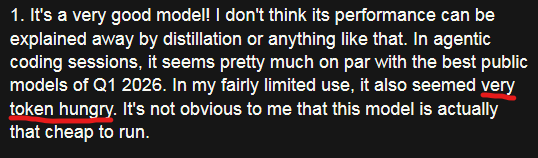
He starts by being direct-honest. Why should he? Because of what I already described. These models are public, therefore there’s no PR gaslighting to be done. Whoever is within this discussion has easily the means to verify these claims, so there’s no room to try and deny the obvious. Doing so you’d lose your leverage because everyone would know you’re lying.

So yeah, these two should be both truths: it’s a “very good model”, and it is “token hungry.”

When he says “it seems on par with the best public models”, he saying including those his own company sells. Notice the specifics, emphasis on Q1 2026. Models seem to evolve quickly, so maybe now he has a better product to sell next, to be a step ahead… See what I already described above. That advantage is eroding quickly.

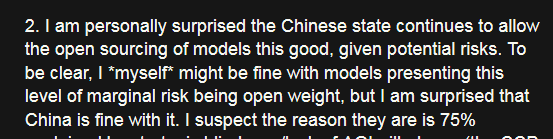
Why, oh why, China is allowing this?

It does make sense, for a centralized type of government/dictatorship that existed by enforcing censorship everywhere, obsessed with control… why would they allow the “open sourcing of models this good,” why wouldn’t they try to keep a tight control, top-down. It all makes sense just as long you have a comic-book, cartoon-parodistic view of China government. Of course the real world is more complex than this. (not to glaze Chinese government)

(I’m not going to comment in detail on the sprinkled rhetorical-fascist propaganda jargon, merely pointing at “AGI-pilledness”, “decelerations/accelerationists”, this individual seems to be rather deep fried by political propaganda. But in this case you could even say that these “descriptions” still work well enough in practice to signify directly.)

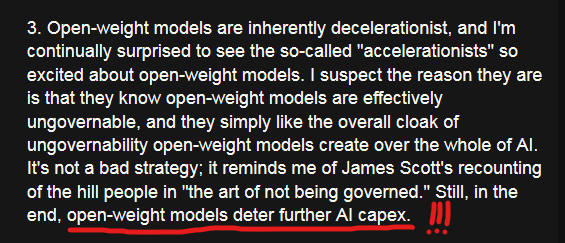
“all this money we’re investing, we are investing FOR YOU!!!”

Cry more tears. He’s complaining that what the Chinese model is doing compromises his own business. Does not like competition. The trick here is by twisting “capex” as a contextual term, outside the level of the single business. ALL capex is reduced, so all investments on AI are reduced = bad.

He’s thinking he’s the center of the world, just like all AI psychopaths. Once you bank all your life and futures on AI, you’re living in hell and permanently committed to its demonic(*) deliverance.

(*) I’m not using “demonic” here as a moral pejorative. AI is demonic IN THEIR OWN accurate views. The part I omitted from the quote implies he sees AI as much more than what’s available today, and believes in true general AGI. In that pure, precise sense of something other than human with metaphysical connotations. It’s literally demonic in the way it exists outside the plane of current knowledge. These techno-fascists see themselves as literal sorcerers to access a new plane of reality.

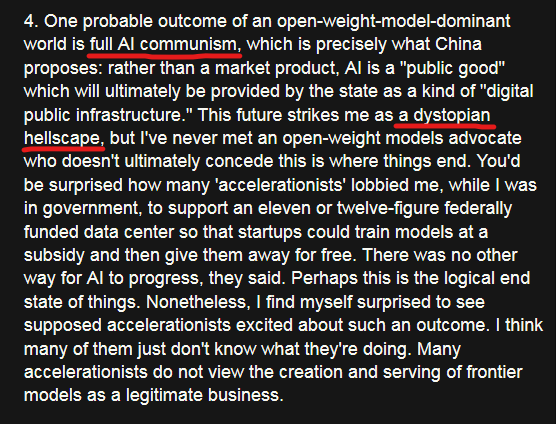
Here comes A CLASSIC. THE RED SCARE. Communism fearmongering.

Oh my! Full AI communism. Dystopian hellscape. AI needs to be exclusive to the hands of sociopathic fascist billionaires, because if instead you make it public there are SECURITY RISKS.

Security risks that VANISH just as long this powerful and dangerous technology is reserved to the private hands of none other than LEX LUTHOR.

You cannot trust governments! You cannot trust the people! YOU CAN TRUST LEX LUTHOR!

Who will certainly always do what’s in YOUR, public interest. Not his!

Security risks! Dystopian hellscape!

Only the billionaires can save you! Trust them, not China!

And here comes the lobbying through oblique language. (You might not know, but this dude was a Trump official just before quitting and going to work for OpenAI. As these people are moved back and forth to lobby public governments into doing their own private interests.)

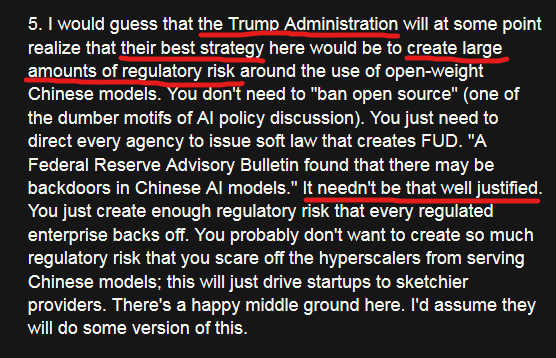
“I would guess”, because I’m humble. Reads instead as: I would pressure the Trump Administration to realize that OUR best strategy is to CREATE (not analyze, not detect, but create out of thin air) large amounts of regulatory risks. In order to stifle the competition when it comes to sell OUR services to OUR US companies.

Because without doing this there would be fastidious capitalist competition in the free market, and our clients might as well be choosing to buy the Chinese services rather than ours.

We can’t have that in this free market system, right? Here comes tariffs, blocks, bans, open market manipulation, lobbying, corruption and everything else that we’ve seen happening under the sun, shamelessly, in the last couple of years.

China offers a competitive product that disrupts the US interests? Block them. We’re libertarian = we’re selfish egomaniacs. Rules only apply to others, not ourselves. There are no morals other than winning advantages at all costs.

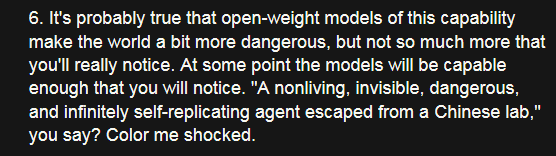
And we conclude with the icing on the cake of the baseless fearmongering (remember? “it needn’t be well justified”).

Open-weight models make the world a bit more dangerous. But you won’t notice, until you have a nonliving, invisible, dangerous, and infinitely self-replicating agent escaped from a lab.

(and notice how he uses a debunked Covid conspiracy theory to bank on his fascists fans sympathies, who love these types of alt histories)

Just remember a basic truth: when fascists detail apocalyptic scenarios, it’s because it’s what they are planning to enact.

Hello world

Corruption is the state.

You should be aware that this is just the beginning, and doesn’t end (won’t end) with Trump.

AI cannot make mistakes

AI cannot ontologically make mistakes. It just can’t.

This might be vaguely philosophical and trivial, but it’s relevant: the moment you accept in the general discourse that AIs make mistakes, is the moment you have already consigned yourself and embraced the narrative that humanizes those AIs.

You’ve shifted the context and now stand on faulty field. AIs follow instructions accurately, they may or may not satisfy the intended product, but are never wrong.

Precisely as expected AIs have now addled the brains (*) of an handful of tech overlords to the point of no return. This is something unprecedented in the history of humanity: never before so much collective effort and resources are focused on a single point: AIs. The same concept of “private property” that has addled our brains. If these individuals decide to pour all their money into one giant bet, then they have their rights to do it. It’s their own money. But it’s not, because these are collective human resources, in the actual real world. It’s all “our” money, that we collectively decided to gift these billionaries and trillionaries, because they are visionaries that will deliver us a better future. Same as in politics, we decide to consign collective power to individuals that we expect will lead us through their exceptional wisdom.

So, someone like Elon Musk, can now burn our collective trillions on his personal gamble. Because he can “afford” it.

There are layoffs everywhere. All technology not only has now stalled, but costs are increasing to absurd levels. Same as it’s absurd that an handful of individuals are so rich that they can single-handedly disrupt entire supply chains. The entire WORLDWIDE demand has been uprooted and supplanted by these individuals that buy everything through infinite resources, and where they cannot reach, corruption compensates.

All this doesn’t make any sense, logically, because when individuals do so much collective DAMAGE. In such a plain and objective, evident “fashion”, then politics steps in to regulate it.

But all this happens AFTER. After democracies have been wiped, after corruption became the rule. After we handed out so much power that individuals have just enough control to rig elections and manipulate. Just enough to bend the world to their own delusions. Just enough to seize the collective day, and shatter it into a wall.

The world is complex, so you need to be precise and divide problems into smaller pieces. People in the game industry look around and see layoffs everywhere. Hardware prices are destroying the whole sector. It’s all one giant FATALISM. We just cannot to anything do stop this. We can just watch it happen. Just like with Covid, we’ve accepted that we might as well get ill, and maybe die. Or be scarred for life.

It’s all the same cause. If people lose their jobs in the game industry, is because someone gotta feed all those AIs. It all one “market.” Because it’s all one world.

Consider all the people that the moon landing in 1969 never actually happened and is one giant conspiracy. The point is, it was one example of giant collective effort. Similar to Manhattan Project. Now we see what happens with something that dwarfs those scales. Now we see how it ends.

(*)
Considering AIs as a mind-virus precisely built to destroy the minds of our richest people might sound quite similar to the “woke mind-virus”… because it is. One core concept of fascist propaganda is accuse your enemy of what you are planning to do. Trump accuses Democrats of cheating in the elections because he’s always has planned and is planning to do it. You can find countless examples. The problem here is that the suicidal tendencies of these individuals are applied to out collective resources. But if we decided to give everything we have to them, then we certainly deserve the apocalyptic outcome. We are collectively building our own deserved annihilation. Once again, enjoy the ride to the ultimate destination.

The reason why literally all these tech giants have sharply pivoted to fascism is simply because the right-wing has evolved through core concepts that are easily exploitable. It all goes around the concept of egoism. The self, the private property, your own personal satisfaction. The right to personal freedom. Right or wrong, they are a lever, used as a tool to manipulate people where they are the most vulnerable. The personal space, the personal anxieties. A capitalist world, made into politics, so that could be exploitable. So that it could move people when they are weakest.